

How to Sell Self-Defense Products on Amazon and eBay — and Build Something That Lasts
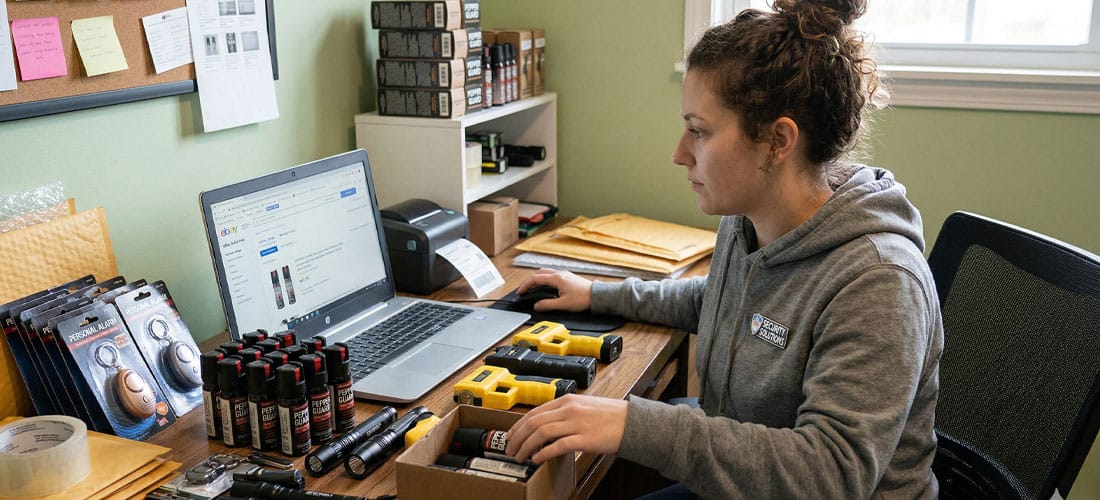
One of the things I noticed early on was how many of our dealers treat Amazon and eBay the way a smart retailer treats a busy street corner — they’re not trying to build a brand there, they’re using the foot traffic. Somebody types “pepper spray keychain” into Amazon and your listing comes up. They’ve never heard of you. They don’t need to. They needed a product, you had it, the transaction happened. What I’ve watched over nearly four decades is that the dealers who do this well aren’t chasing marketplace dominance. They’re using the platforms to find customers they’d never have reached any other way — and then building a real relationship from there. That’s a different way of thinking about it, and it’s worth understanding before you start.
Why Selling Self-Defense Products on Amazon and eBay Works
The marketplace advantage is simple: Amazon and eBay have already done the hard part. They built the audience, they earned the trust, and they put up the infrastructure. When somebody decides they want a stun gun or a can of pepper spray, millions of them start on Amazon. They’re not browsing — they already made the decision. Your job is to be there with the right product at a price that makes sense.
Self-defense products are a natural fit for marketplace selling because the purchase is driven by need or a specific triggering event, not brand loyalty. A woman who just moved to a new city wants pepper spray. A parent sending a kid to college wants a personal alarm. They type what they want, they find it, they buy it. They don’t comparison shop for months. That kind of buyer converts well on marketplaces — and it’s a buyer who often comes back, or tells someone else.
There’s also a discovery element that surprises some of our dealers. Customers who find you on Amazon and have a good experience will Google your store name afterward. They’ll come to you directly next time. I’ve had dealers tell me that a third of their direct website orders come from people who first found them on a marketplace. That’s the real play here — using the platform’s traffic to build your own list.
eBay functions a little differently. It skews toward buyers who are comparing prices and looking for deals, and it’s particularly strong for used goods and specialty items. For new self-defense products, Amazon tends to outperform it — but eBay is worth running alongside it. The incremental effort is low once your listings exist, and it catches a different segment of buyer.
What Moves on Marketplaces: The Products That Sell
Pepper & Defense Sprays — 50–57% Dealer Margin
Pepper spray is the highest-volume self-defense category on Amazon, and for good reason — it’s the product most buyers are comfortable with, it ships without the legal complexity of stun guns, and the $10 to $25 price range sits squarely in impulse-buy territory. Brands like Pepper Shot, Wildfire, and Mace have real recognition that helps your listings convert. Keychain units and compact canisters move fastest; display units and larger formats do well when you build out a storefront with repeat buyers. One pro tip for marketplace sellers: product images matter enormously at this price point — buyers can’t handle the product, so the photos and title have to do the work.
Personal Safety — 48–77% Dealer Margin
Personal alarms are one of the cleanest categories to sell on any online marketplace — no legal restrictions anywhere in the country, broad buyer demographic, and a price range ($8 to $30) that converts with almost no friction. They’re strong gift-market items too, which means seasonal spikes around graduation, back to school, and the holidays. Search volume for personal alarm on Amazon is consistent year-round with predictable peaks. If you’re starting out and want a low-risk category to test marketplace selling, this is where I’d begin.
Covert Security — 45–60% Dealer Margin
Diversion safes perform unusually well online because they’re a product people often discover rather than search for specifically. A buyer browsing for a safe stumbles onto a working Wall Safe that looks exactly like a can of WD-40, and they’re intrigued. That discovery dynamic works in your favor on marketplace platforms, where related product algorithms surface your listings to buyers who weren’t looking for you. Hidden cameras also perform well, particularly those that don’t require ongoing subscriptions — buyers on Amazon are skeptical of recurring fees. No legal restrictions on either category in any state, which keeps the listing process clean.
You’ll see wholesale prices for all of these — and every other category — once you complete the dealer application. There’s no cost and no commitment.
A Real Example: Hundreds of Dealers. Nearly $3 Million in Online Sales.
Steve Thibeault started TBO-Tech out of a spare bedroom. He wasn’t a technology expert. He wasn’t a retail veteran. He was someone who saw an opportunity to build an online business selling self-defense products and was willing to work at it.
Since 2000, TBO-Tech has done nearly $3,000,000 in online sales. The operation has grown from a bedroom into 2,200 square feet with a full-time employee. Thibeault’s business now operates its own website, sells across multiple online channels, and has become one of the more recognizable independent retailers in the self-defense space. It started with a dealer application and a spare room.
I tell that story not to suggest that’s what everyone does — most people aren’t looking to build TBO-Tech. But it illustrates what’s possible when someone takes the online channel seriously, works at it consistently, and uses the platforms to build something real rather than just list products and hope. Steve’s path started the same way yours would: apply, get authorized, see the wholesale prices, start listing.
What You Actually Need to Get Started Selling on Amazon and eBay
The barrier to entry is lower than most new dealers expect. You’ll need a seller account on whichever platform you’re starting with — Amazon’s Professional selling plan runs $39.99 per month; eBay charges a percentage of sales with optional store subscriptions. Neither requires significant upfront cost to open. The more important question is how you want to fulfill orders.
Most of our dealers who are new to online selling start with drop shipping. You list the products, collect payment from the marketplace, then order from us to fulfill. We ship the same day, blind, with no drop ship fee. Your customer gets the product, you keep the margin. No warehouse, no inventory risk, no guessing what to stock. Once you’ve identified your best performers, some dealers shift to carrying inventory for faster ship times or Amazon FBA eligibility — but that’s a decision you make after you know what sells, not before.
What takes real work is the listing side. Marketplace success comes down to title optimization, clean product images, accurate descriptions, and competitive pricing. None of that is complicated, but it takes attention. New dealers who treat their first dozen listings as tests — checking what’s getting views, what’s converting, what’s getting questions — figure out the channel faster than those who list everything at once and wait.
One honest thing to know going in: Amazon’s policies around weapons and self-defense products shift periodically. Stun guns, in particular, have faced listing restrictions in certain categories. Pepper spray and personal alarms have been more consistently permitted. Check Amazon’s current restricted products policy directly before you build your listing strategy around any specific category.
How Safety Technology Makes Online Marketplace Selling Easier
The mechanics of marketplace drop shipping depend on fast, reliable fulfillment — and that’s where we have an advantage that directly affects your seller metrics. Same-day shipping means your orders go out the day they come in. On Amazon, your seller rating and Buy Box eligibility are tied to shipping speed and on-time delivery. We process and ship same day, which protects your metrics and your reputation as a seller.
No minimum order means you can test new SKUs without commitment. If you want to add a new hidden camera model to your Amazon store, you don’t have to order a case of them first. List it, see how it performs, order to fulfill if it sells. That flexibility matters on a platform where trending products change and you need to respond quickly.
And no drop ship fee means the math stays clean. On a marketplace where you’re already paying platform fees, adding a per-order drop ship charge would eat margin fast. We don’t charge one. What you see at wholesale is what you pay to fulfill the order. That’s how it works, and it’s been how it works since 1986.
A: It depends on the product and the platform’s current policies. Pepper spray, personal alarms, diversion safes, and hidden cameras are generally permitted on both platforms. Stun guns are more restricted — Amazon limits them in certain categories and eBay has specific listing rules by jurisdiction. We always recommend reviewing each platform’s seller policies directly before you list. Our dealers who concentrate on the unrestricted categories move a lot of product without any platform friction. You can check state-level stun gun laws at https://www.safetytechnology.com/stun-gun-laws/ as a starting point.
A: When a customer places an order on your marketplace listing, you send us the shipping address and we fulfill it the same day from our warehouse. The package ships blind — our name is not on it, only yours. There is no drop ship fee. You keep the margin between what your customer paid and what you paid us at wholesale. Most of our online dealers run it exactly that way, particularly when they’re starting out and want to test the channel before they commit to holding inventory.
A: Our wholesale dealer margins run from 40 to 77 percent depending on the category. After marketplace fees — Amazon typically takes 8 to 15 percent depending on category, eBay is in a similar range — you’re still working with solid margins on the right products. Pepper spray, personal alarms, and diversion safes hold their price well online because buyers aren’t hunting for the absolute cheapest option; they’ve already decided they want the product and they’re buying. That’s a different kind of customer than a commodity shopper.
A: No minimum order, ever. You can list products using drop shipping to test what sells before you carry any inventory at all. When a product proves itself, you can start stocking it if you want faster fulfillment times or FBA eligibility. Most of our dealers who are new to online selling start with drop shipping, identify their best performers over two or three months, and build their inventory strategy around real data. It is a low-risk way to learn the channel before you commit money to stock.
A: Returns are handled between you and your marketplace customer, the same as any seller on those platforms. We stand behind the quality of our products — if something arrives defective, work with us directly and we’ll make it right. The more common situation is a buyer who changed their mind or selected the wrong size. Having a clear, straightforward return policy posted on your listing resolves most of that before it becomes a problem. Amazon’s and eBay’s buyer protection policies will also set expectations for your customers, so it’s worth reading them when you set up your account.