

How to Build a Mail Order Self-Defense Business — No Storefront, No Inventory, No Minimum Orders
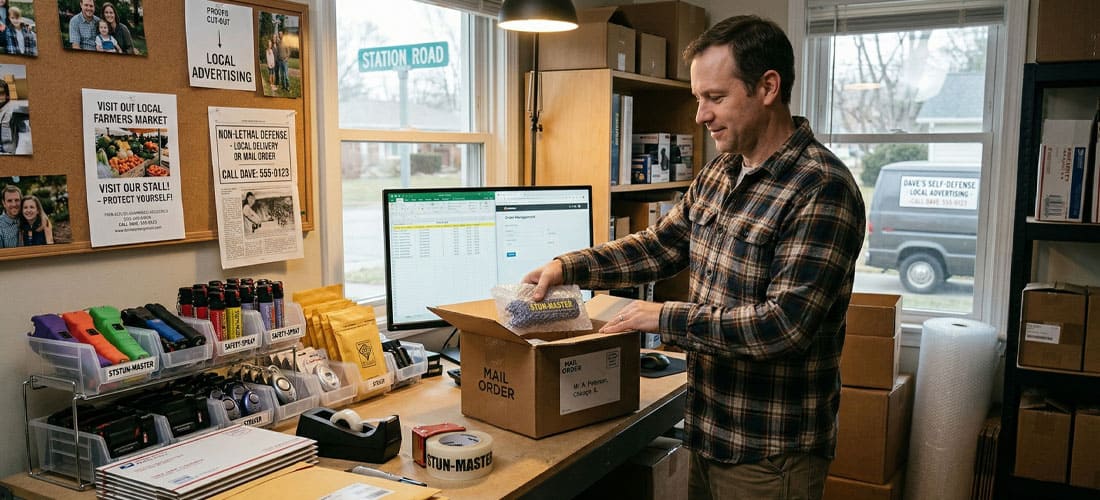
A retired Chicago police officer placed four small classified ads in local publications — nothing fancy, just straightforward crime-prevention offers with a phone number. He wasn’t running a storefront. He wasn’t doing shows on weekends. He was barely working at it, by his own account. Last year those four ads put over $9,000 in profit in his pocket. I think about that dealer whenever someone tells me mail order is dead. It’s not dead. It just moved to where your buyers actually are.
Why Mail Order and Local Advertising Work for Self-Defense Products
Self-defense products have something most mail order categories don’t: a buyer who is already motivated. Nobody needs to be convinced they want to feel safer. The need is there. The question is whether your ad shows up at the right moment, in the right place, for the right buyer. That’s a much easier problem to solve than creating demand from scratch.
Local advertising has an advantage that national campaigns don’t: trust. When someone sees a crime-prevention ad in a neighborhood publication or a church bulletin, it reads as a community resource, not a commercial pitch. Our dealers have found that buyers in that context are quicker to pick up the phone and more likely to buy multiple items — a pepper spray for themselves, a personal alarm for their mother, a hidden camera for the garage. The community framing does real selling work.
The other thing working in your favor: this channel is cheap to test. A classified ad in a local shopper might cost you $30. A spot in a crime-watch newsletter could be free if you frame it as a safety resource. You’re not committing to a trade show booth or a lease. You place an ad, you measure the response, and you adjust. That kind of low-risk iteration is how smart dealers find what works in their market — and then scale it.
Mail order also scales quietly. Once you find an ad that pulls, you can run it repeatedly in the same publication, test it in similar ones, and build a steady incoming order flow — often without being present at all. A lot of our dealers run mail order alongside another channel. It becomes the business that works while they’re doing something else.
What Moves in Mail Order: The Products That Sell
Pepper & Defense Sprays — 40–50% Dealer Margin
Pepper spray is the single easiest self-defense product to sell by mail because buyers already know what it is and why they want it. You don’t have to explain the product — you just have to put your offer in front of someone who has been thinking about getting one. Brands like Wildfire, Pepper Shot, and Mace have consumer recognition that eliminates the educational step. In mail order, that matters: a buyer reading your ad has seconds to decide, and a familiar product name closes the gap. Price points in the $10–$25 retail range make it a low-hesitation purchase, and buyers regularly add a second or third unit to an order.
Personal Safety — 48–77% Dealer Margin
Personal alarms, door alarms, and safety keychains are ideal mail order products for two reasons: they have no legal restrictions in any state, so you can advertise them nationally without worrying about where the order ships; and they have genuine gift market appeal that broadens your buyer pool well beyond the self-defense enthusiast. An ad offering a personal alarm as a gift for a college student, an elderly parent, or a solo commuter reaches buyers who would never search for self-defense products on their own — but respond immediately when the right message lands in front of them. Margins in this category run among the highest in the catalog.
Covert Security — Consistent Performer Across Price Points
Diversion safes and hidden cameras sell well in mail order because they solve a specific problem buyers feel acutely — protecting valuables at home — and because there are no legal restrictions in any state. Diversion safes in particular are an easy impulse addition to any order: a buyer calls for pepper spray, you mention the book safe, and you’ve just increased the order by $20. In advertising, a headline like “The Home Safe Nobody Will Ever Find” almost writes itself, and the curiosity it creates pulls strong response. This category also sells consistently year-round, which matters if you’re running a recurring ad campaign.
You’ll see wholesale prices for all of these — and every other category in the catalog — once you complete the dealer application. There’s no cost and no commitment.
A Real Example: Four Small Ads, $9,000 in Profit
I want to tell you about a dealer I’ve known for years. Retired Chicago police officer. He wasn’t looking to build an empire — he wanted to do something useful in retirement that brought in real money without demanding his whole schedule. He knew personal safety. He knew his community. So he started there.
He placed four small ads in local Chicago-area publications — classified-style, straightforward crime-prevention offers. No fancy website. No trade show booth. No employees. He’d take orders, place them with us, and we’d ship. By his own account, he wasn’t working hard at it. Last year those four ads generated over $9,000 in dealer profit. He’d found the right message, the right publications, and a buyer pool that responded — and then he let it run.
What this dealer figured out is something I’ve watched work over and over: when you match the right product to the right audience through the right local channel, you don’t have to sell very hard. The buyers come to you. The job becomes fulfilling orders, not chasing customers.
What You Actually Need to Get Started with Mail Order and Local Advertising
The barrier to entry here is genuinely low. You need a phone number or a mailing address to put in an ad, a way to take payment (a simple PayPal account or a phone with Square will do it), and approval as a Safety Technology dealer so you can see wholesale prices and place orders. That’s the short list.
On the advertising side, start with publications you already know — your local community paper, a neighborhood newsletter, a publication serving a specific buyer group you understand. A $30 test ad tells you more than any amount of planning. If it pulls, run it again. If it doesn’t, try a different headline or a different publication. Most dealers find their footing within two or three iterations. The ones who quit do so after one ad that didn’t work, which is usually an ad with a weak headline — not a broken channel.
What Safety Technology provides is the catalog, the wholesale pricing, same-day shipping, and the ability to drop ship directly to your customers if you don’t want to handle fulfillment yourself. What you handle is the advertising, the incoming orders, and the customer relationship. Beyond a computer and a phone, there’s no equipment required, no lease, and no employees needed to get started.
One thing new dealers sometimes underestimate: headline writing matters more than almost anything else in mail order. A great product in a bad ad gets ignored. Take time with your copy, or model it after ads in your target publications that have been running for years — longevity in a publication usually means the ad is working.
How Safety Technology Makes Mail Order Easier
The mechanics of the Safety Technology model were practically designed for mail order. No minimum order means you never have to buy ahead of demand — an order comes in, you place it with us, and we ship it the same day. Your customer gets their product fast. You never have a garage full of inventory you’re hoping to move. That kind of capital efficiency is hard to find in any wholesale relationship.
Drop shipping is where this really comes together. We ship blind — your name on the package, not ours — at no extra charge. There’s no per-order drop ship fee eating into your margin. For a mail order operation, that means every order you take is a profitable order, not one where you’re calculating whether the drop fee still leaves you in the black. You set your retail price, we ship to your customer, you keep the difference.
After nearly 40 years in this business, we’ve worked with enough mail order dealers to know what products photograph well in an ad, what price points trigger a call, and which categories hold up year-round versus which ones are seasonal. That’s not something you get from a catalog — it comes from experience. We’re happy to share what we know when you call.
A: The startup cost is lower than most people expect. There’s no inventory requirement — you can order as little as one unit at a time. Your main upfront expenses are a dealer application fee of $35 if you’re starting from scratch, and whatever you choose to spend on advertising. A classified ad in a local publication can run $20 to $100. Most dealers start with a small test ad, see what comes back, and scale from there.
A: Classified sections in community newspapers, shopper publications, and local penny-saver-style papers have worked well for our dealers for decades. Crime-watch newsletters, church bulletins, and neighborhood association mailers are also worth testing — the audience is already thinking about safety. Small display ads in the right publication consistently outperform larger ads in the wrong one. Match the publication to the buyer: a parents’ magazine for personal alarms, a gun publication for stun guns and pepper spray.
A: Not if you use Safety Technology’s drop shipping. When an order comes in, you place it with us and we ship directly to your customer — blind, with your name on the package, not ours. There’s no drop ship fee, and we process and ship the same day. That means you can run a mail order business without a warehouse, without carrying stock, and without tying up capital in inventory you may or may not sell.
A: It depends on the product and the destination. Pepper spray ships to most states with no restrictions. Stun guns have more variability — some states restrict or prohibit them entirely, and shipping across state lines adds another layer of consideration. Before you advertise a product for mail order, it’s worth checking the destination state’s laws. We maintain a current guide at https://www.safetytechnology.com/stun-gun-laws/ that covers restrictions by state. Personal alarms and diversion safes have essentially no legal restrictions anywhere and are safe choices for a national mail order campaign.
A: Returns are handled between you and your customer — you set your own return policy. Because you’re buying wholesale and selling retail, you have margin to work with if a return comes in. In practice, self-defense products have low return rates. Most buyers purchase because they have a real need, and the products work as described. If something arrives damaged or defective, Safety Technology stands behind the products on our end, so you’re not absorbing those costs alone.