


Quick Answer
Effective stun gun use requires proper technique, not just ownership:
Key techniques: Firm contact against large muscle groups (chest, shoulders, neck, thighs) for 2-5 seconds minimum. Push into target—don’t just touch surface. Maintain pressure throughout electrical cycle. Escape immediately after deployment.
Target areas (most to least effective): Upper chest/shoulders (85-90% effectiveness), ribcage/torso (80-85%), upper arms (70-75%), lower abdomen (65-70%). Avoid face, directly over heart, and genitals.
Monthly maintenance required: Test device (1-second spark in air), charge fully even if unused, clean electrodes with alcohol swab, inspect for damage. Practice drawing and activating weekly for first month, then monthly.
Legal use requirements: Only when you reasonably fear imminent physical harm. Force must be proportional to threat. You cannot be initial aggressor. Call 911 immediately after use to establish you were victim.
Common mistakes to avoid: Brief contact (must hold 2-5 seconds), poor target selection (hands/feet ineffective), forgetting to charge, carrying with safety off, and hesitating during actual threat.
New to stun guns? Read our Stun Gun Buyer’s Guide
Table of Contents
- Understanding How Stun Guns Work
- Before You Need It: Preparation and Practice
- Proper Stance and Grip
- Target Areas for Maximum Effectiveness
- Contact Duration and Technique
- Deployment in Different Scenarios
- After Deployment: What to Do Next
- Safety Rules and Precautions
- Common Mistakes to Avoid
- Legal Considerations for Use
Owning a stun gun is only the first step in effective self-defense—knowing how to use it properly can mean the difference between successfully stopping an attack and putting yourself in greater danger. Many people purchase stun guns for protection but never practice deployment, don’t understand proper contact points, or aren’t sure when legal use is justified.
This comprehensive guide covers everything you need to know about using a stun gun effectively and safely, from proper grip and stance to target areas, contact duration, and legal considerations.
Understanding How Stun Guns Work
Before learning technique, it’s important to understand what happens when a stun gun is deployed.
The Electrical Charge
Stun guns deliver high voltage (1-15 million volts typically) but low amperage electrical current. The voltage penetrates clothing and creates an electrical arc, while the amperage (measured in milliamps) affects the body.
When electrical current enters the body, it:
- Disrupts voluntary muscle control by overwhelming the nervous system
- Causes involuntary muscle contractions
- Produces intense pain and disorientation
- Temporarily impairs balance and coordination
These effects are temporary—typically lasting seconds to a few minutes—and don’t cause permanent damage when devices are used as designed.
KEY TAKEAWAY
Direct contact is essential. Stun guns require firm pressure against the body—electricity needs physical connection to travel into muscles. Clothing reduces effectiveness, so apply extra pressure through thick layers. Air gaps prevent electrical transfer except the visible arc between electrodes.
Why Direct Contact Is Essential
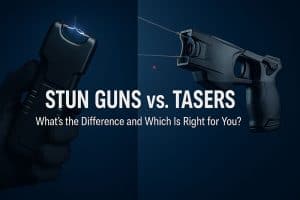
Unlike Tasers which fire projectiles, stun guns require direct contact because:
- Electricity needs physical connection to travel into muscles
- Clothing reduces effectiveness (multiple layers can block current)
- Air gaps prevent electrical transfer except the visible arc between electrodes
Before You Need It: Preparation and Practice
Know Your Device Inside and Out
Familiarize yourself with your specific model:
- Locate the safety switch (most have one to prevent accidental activation)
- Understand activation method (button, trigger, or slide switch)
- Know if there’s a test button (tests spark without full discharge)
- Identify charging method (USB, wall plug, etc.)
- Locate the electrodes (points that must contact attacker)
- Understand additional features (flashlight, alarm, disable pin)
Read your user manual thoroughly and keep it accessible for reference.
Regular Testing and Maintenance
Monthly testing protocol:
- Fully charge the device
- In a safe area, disengage safety and test spark in air (1-second burst)
- Verify strong, bright arc and loud crackling sound
- Weak spark indicates low battery or malfunction
- Inspect for damage, cracks, or corrosion on electrodes
- Verify safety switch operates properly
- Recharge immediately after testing
Practice Deployment Regularly
Building muscle memory through practice:
Drawing practice: Practice removing device from pocket, purse, or holster. Time yourself—should be under 2 seconds. Practice with both dominant and non-dominant hand. Try from various positions (sitting, standing, lying down).
Safety disengagement: Practice flipping safety off smoothly without looking. This should become automatic under stress. One fluid motion from drawing to ready.
Simulated contact: Use pillow or punching bag as practice target. Practice motion of pressing device firmly and holding. Don’t activate on practice targets—just practice the motion.
Practice frequency: Weekly for first month (building muscle memory), monthly thereafter (maintaining skills), and before travel or high-risk situations.
Carry Accessibility
Your stun gun does no good buried in your bag. Ideal carry methods:
- Dedicated pocket: Easily reached with dominant hand, nothing else in pocket
- Belt holster: Quick-draw access, secure retention
- Purse side pocket: Not bottom where items pile on top
- Jacket pocket: Immediate access in parking lots or evening walks
- Lanyard or wrist strap: Prevents dropping or disarming
Proper Stance and Grip
Defensive Stance
When threat approaching but not yet in contact:
- Face threat directly: Never turn sideways—limits mobility and vision
- Feet shoulder-width apart: Stable base, ready to move
- Knees slightly bent: Absorbs impact, ready to push or retreat
- Non-dominant hand forward: Creates barrier, protects face and body
- Dominant hand with stun gun ready: Not yet raised—element of surprise
- Weight balanced: Ready to move in any direction
- Eyes on attacker: Maintain visual contact, watch for sudden movements
Proper Grip
Holding the stun gun effectively:
- Firm but not tense: Too tight reduces speed and control
- Fingers wrapped around handle: Not just fingertips
- Thumb near activation button: Ready for immediate deployment
- Wrist straight: Not bent—reduces power and accuracy
- Device positioned for contact: Electrodes facing forward
- Elbow slightly bent: Not locked—allows for push and movement
KEY TAKEAWAY
Practice makes perfect under stress. Monthly testing and regular deployment drills build the muscle memory necessary for successful defense. When you can draw, disengage safety, and deploy without thinking, you’ve developed the automatic response that saves lives in emergencies.
Target Areas for Maximum Effectiveness
Primary Target Areas (Most Effective)
Upper body targets:
1. Neck and shoulder area: High concentration of nerve endings, large muscle groups affected, difficult for attacker to defend, causes immediate disorientation, and accessible from front or side approach. Caution: Avoid direct throat—potential breathing complications.
2. Upper chest/below collarbone: Large muscle mass (pectoral muscles), close to vital nerve centers, difficult to block or defend, effective from frontal approach, and relatively safe target (away from face and throat).
3. Ribcage/side torso: Large muscle groups, good contact area even through clothing, accessible if attacker grabs you, and effective for close-quarters defense.
Secondary targets (effective but less ideal):
4. Upper arms/biceps: Good muscle mass, causes arm dysfunction (limits grabbing ability), accessible target, and useful if attacker reaching for you.
5. Lower abdomen/hip area: Core muscle groups affected, can cause loss of balance, accessible in grappling situations, and effective in close combat.
6. Upper thighs: Large leg muscles (quadriceps), causes leg weakness and instability, accessible if attacker on ground or you’re escaping ground position, and can prevent pursuit.
| Target Area | Effectiveness | Accessibility | Notes |
|---|---|---|---|
| Upper chest/shoulder | 85-90% | High | Best overall target |
| Ribcage/torso | 80-85% | High | Good for side attacks |
| Upper arms | 70-75% | Medium | Limits grabbing |
| Lower abdomen | 65-70% | Medium | Core disruption |
| Hands/feet | 40-50% | Low | Avoid—ineffective |
Areas to Avoid
Don’t target these areas:
- Face and head: Risk of serious injury (eyes especially), may be considered excessive force legally, difficult to maintain contact (head moves easily)
- Directly over heart: While stun guns are designed to be safe, avoid prolonged contact over heart especially if attacker has known heart conditions
- Genitals: May be considered excessive force, difficult to defend legally, alternative targets equally or more effective
- Hands and lower arms: Small muscle mass, less effective, attacker can easily pull away, may result in device being grabbed
- Feet and lower legs: Small muscle mass, difficult to maintain contact, limited effectiveness, requires dangerous positioning (bending down)
Contact Duration and Technique
How Long to Make Contact
Recommended contact times:
Half-second burst: May startle attacker, causes pain and discomfort, often enough to create opportunity to escape, and minimal electrical transfer.
1-2 second contact: Causes muscle spasms and pain, may daze attacker briefly, often sufficient for most situations, and recommended starting point.
3-5 second contact: Causes significant disorientation, muscle dysfunction lasts longer, high likelihood of attacker falling or losing balance, and recommended for determined attackers.
5+ second contact: Maximum incapacitation, effects last several minutes, use only if shorter durations ineffective, and may be considered excessive in some situations—use judgment.
General rule: Start with 2-3 seconds. If attacker still threatening, apply again. Multiple shorter applications often more effective than single long contact.
KEY TAKEAWAY
Contact duration is critical. The #1 mistake is insufficient contact time—brief touches won’t incapacitate. Push electrodes firmly into target and hold for minimum 2-3 seconds. Think “push and hold” not “tap and pull away.” Proper duration makes the difference between success and failure.
Proper Contact Technique
Making effective contact:
- Firm pressure: Press electrodes firmly against body, not just touching surface. Push into target—electrical current needs good contact.
- Hold position: Keep electrodes in contact during entire electrical cycle. Don’t pull away immediately—maintain pressure throughout.
- Drive through target: Push forward as if reaching through attacker. Creates firm contact, prevents attacker from pulling away, and delivers maximum electrical charge.
- Maintain activation: Hold trigger/button down throughout contact. Interrupted electrical flow reduces effectiveness.
- Multiple points if possible: Some stun guns have electrodes in multiple locations. Try to get as many touching as possible—increases current flow.
What to Expect During Contact
Attacker’s likely reactions:
- Immediate muscle contraction and tensing
- Loud yelling or screaming (pain response)
- Attempts to pull away (instinctive reaction)
- Loss of balance or falling (muscle dysfunction)
- Disorientation and confusion
- Temporary paralysis in affected muscles
Your experience during deployment:
- Loud crackling sound (very audible—good deterrent)
- Bright electrical arc visible
- Vibration in device (normal operation)
- Physical feedback as attacker reacts
- You will NOT be shocked (electricity goes into attacker, not back to you)
Deployment in Different Scenarios
Parking Lot or Street Attack
Scenario: Someone approaches aggressively in parking lot or on street.
Response protocol:
- Verbal deterrent first: “Stay back! I don’t want trouble!” Loud voice draws attention and establishes you warned attacker.
- Create distance: Back away while maintaining visual contact. Use parked cars or barriers to create obstacles.
- Display device: If threat continues, show stun gun and activate spark in air (visible arc and sound often deters). “I have a stun gun and will use it!”
- Deploy if necessary: If attacker continues despite warnings, use stun gun. Target upper body, 2-3 second contact, immediate escape after.
- Call police: Report assault from safe location.
Being Grabbed or Restrained
Scenario: Attacker has grabbed your arm, clothing, or is restraining you.
Response protocol:
- Don’t panic: Controlled response more effective than panic.
- Quick access: Grab stun gun with free hand if possible. If both hands restrained, struggle to free one hand.
- Target accessible areas: Side torso, arm, or leg—whatever you can reach. Don’t worry about “best” target—any contact helps.
- Short, repeated bursts: 1-2 second contacts repeatedly. Multiple applications quickly overwhelm attacker.
- Create space and escape: As soon as attacker’s grip loosens, pull away forcefully. Don’t wait for complete incapacitation—escape immediately.
KEY TAKEAWAY
Escape is the goal, not domination. Stun gun creates an opportunity to escape—use it. Don’t stand over attacker after deployment. Maximum distance immediately after application. Move to safety, then call police. Your goal is safety, not subduing the attacker.
Multiple Attackers
Scenario: Facing more than one attacker (extremely dangerous situation).
Response protocol:
- Prioritize escape: Multiple attackers likely overwhelm any self-defense tool. Your goal is escape, not confrontation.
- Target primary threat: Identify most immediate danger. Deploy against closest or most aggressive attacker.
- Quick application: 1-2 second burst to create opening. Don’t try to fully incapacitate—just create escape opportunity.
- Move immediately: As soon as you create opening, run toward safety. Don’t engage second attacker unless necessary.
- Draw attention: Yell, scream, activate car alarm if near vehicle. Multiple attackers fear witnesses.
- Call police immediately: Report from safe location.
After Deployment: What to Do Next
Immediate Actions
- Escape to safety: Don’t wait around to see if attacker recovers. Create maximum distance immediately. Get to populated area, business, or secured location.
- Call 911: Report attack as soon as safe. Provide your location, description of attacker, and direction attacker went. Explain you defended yourself with stun gun (establishes you were victim).
- Stay on scene if safe: Police will want statement. If unsafe to stay, tell 911 dispatcher you’re leaving to safe location and where you’ll be.
- Document injuries: Take photos of any injuries attacker caused you. Note torn clothing, bruises, or marks. These document you were attacked.
- Get witness information: If anyone saw attack, get their contact information. Witnesses corroborate your account.
Interacting With Police
When police arrive:
- Cooperate fully and be honest
- Explain you were attacked and defended yourself
- Show your stun gun (don’t hide it—looks suspicious)
- Provide basic facts: who, what, when, where
- You have right to attorney—you can request one before detailed statement
- Don’t minimize what happened—you were in genuine danger
- Don’t embellish—stick to facts
Safety Rules and Precautions
Safe Storage
Preventing accidents and unauthorized use:
- Engage safety when stored: Safety switch on at all times except when carrying in ready position
- Keep away from children: Store out of reach, explain danger if children see it, consider locked storage
- Separate from keys/metal objects: Prevents accidental activation, avoids damage to electrodes
- Avoid extreme temperatures: Don’t leave in hot car (damages battery), don’t expose to freezing (reduces effectiveness)
- Dry storage: Moisture can damage electronics, keep in dry environment
Handling Safety
Preventing accidental discharge:
- Always use safety switch: Only disengage when actually threatened
- Never test on people or animals: Even as joke—causes injury and trauma
- Don’t test on flammable materials: Electrical spark can ignite gasoline, alcohol, etc.
- Never test in or near water: Water conducts electricity—dangerous to you and device
- Don’t activate near electronic devices: Can damage phones, computers, medical devices
- Handle with respect: Treat as serious self-defense tool, not toy
KEY TAKEAWAY
Training is non-negotiable. The best stun gun in the world is useless if you haven’t practiced deployment. Spend 10 minutes weekly for the first month practicing draw, safety disengagement, and simulated contact. This small time investment could save your life.
Common Mistakes to Avoid
Mistake #1: Never Practicing
Problem: Many people buy stun gun and never practice drawing or activating it. In emergency, fumbling with unfamiliar device can be fatal.
Solution: Practice weekly for first month, then monthly thereafter. Build muscle memory so deployment is automatic.
Mistake #2: Inadequate Contact Duration
Problem: Touching stun gun to attacker for split second and immediately pulling away. Insufficient electrical charge to incapacitate.
Solution: Maintain firm contact for minimum 2-3 seconds. Push into target and hold throughout electrical cycle.
Mistake #3: Poor Target Selection
Problem: Targeting hands, feet, or other small muscle groups. Minimal effectiveness.
Solution: Target large muscle groups—upper chest, shoulders, neck, thighs. Maximum effectiveness.
Mistake #4: Forgetting to Charge
Problem: Device has dead battery when needed. Completely useless without power.
Solution: Charge monthly even if unused. Test monthly to verify charge. Recharge immediately after testing.
Mistake #5: Hesitating During Attack
Problem: Freezing or hesitating when actually attacked. Indecision allows attacker advantage.
Solution: Mental preparation through visualization. Imagine scenarios and your response. Decisive action when threatened.
Legal Considerations for Use
When You Can Legally Use a Stun Gun
Self-defense legal standard: You reasonably believe you’re in imminent danger of unlawful physical harm (not just insults or threats—actual physical danger anticipated). Force used is proportional to threat (stun gun appropriate for physical attack, not for verbal argument). You’re not the initial aggressor (didn’t start or escalate confrontation). You have no reasonable means of escape (duty to retreat states—not all states require this).
When You CANNOT Legally Use a Stun Gun
Illegal uses that result in criminal charges:
- Verbal arguments or insults (words alone don’t justify physical force)
- Property disputes (can’t use force to recover property or remove trespassers—call police)
- Retaliation or punishment (can’t use after threat has ended)
- Intimidation or coercion (threatening use to control someone’s behavior)
- Against police or law enforcement (resisting arrest, even unlawful arrest in most states)
- Protecting property only (in most states, can’t use force solely to protect property)
Conclusion: Confidence Through Preparation
Owning a stun gun provides peace of mind, but true confidence comes from knowing how to use it effectively. The techniques covered in this guide—proper stance and grip, target selection, contact duration, scenario-specific deployment, and safety protocols—transform a stun gun from a passive deterrent into an active, reliable self-defense tool.
The key to effective stun gun use is simple: practice, practice, practice. Monthly testing and regular deployment drills build the muscle memory and confidence necessary for successful defense under stress. When you can draw, disengage the safety, and deploy your stun gun without thinking, you’ve developed the automatic response that saves lives in emergencies.
Essential Takeaways
- Know your device intimately: Understand every feature, button, and function before you need it
- Practice regularly: Weekly initially, monthly thereafter—muscle memory saves lives
- Target large muscle groups: Upper chest, shoulders, neck, and thighs for maximum effectiveness
- Maintain firm contact for 2-5 seconds: Insufficient contact duration is the most common mistake
- Escape immediately after deployment: Your goal is safety, not subduing the attacker
- Call 911 after any use: Establish yourself as victim and get medical/legal help
- Use only in legitimate self-defense: Understand legal boundaries to avoid criminal charges
- Keep device charged and ready: Test monthly, recharge regularly, maintain accessibility
- Combine with awareness: Stun gun is backup—awareness and avoidance are primary defense
Your Next Steps
- This week: Read your stun gun’s user manual thoroughly. Test device to ensure it’s charged and functioning. Practice drawing from your carry location 20 times.
- This month: Establish regular charging schedule. Practice deployment scenarios weekly. Identify target areas on practice dummy or pillow.
- Ongoing: Monthly testing and charging. Weekly visualization exercises. Consider formal self-defense training. Stay current on local laws regarding use and carry.
Remember: the best self-defense tool is the one you have with you, know how to use, and deploy confidently when necessary. Your stun gun is only as effective as your training and preparation. Invest time now in mastering these techniques—your safety may depend on it.
Stay safe, stay prepared, and carry with confidence knowing you have both the tool and the skills to protect yourself.
Explore Quality Stun Guns and Training Tools
Disclaimer: This article provides general educational information about stun gun self-defense techniques. It is not a substitute for professional self-defense training or legal advice. Self-defense laws vary by state and situation. Always verify current laws in your jurisdiction. Use stun guns only in legally justified self-defense situations. Improper or illegal use can result in criminal charges and civil liability. The author and Safety Technology assume no responsibility for consequences resulting from use or misuse of information in this article. When in doubt, consult legal counsel and seek professional self-defense instruction.