

Home Parties: A Serious Way to Sell Self-Defense Products to People Who Already Trust You
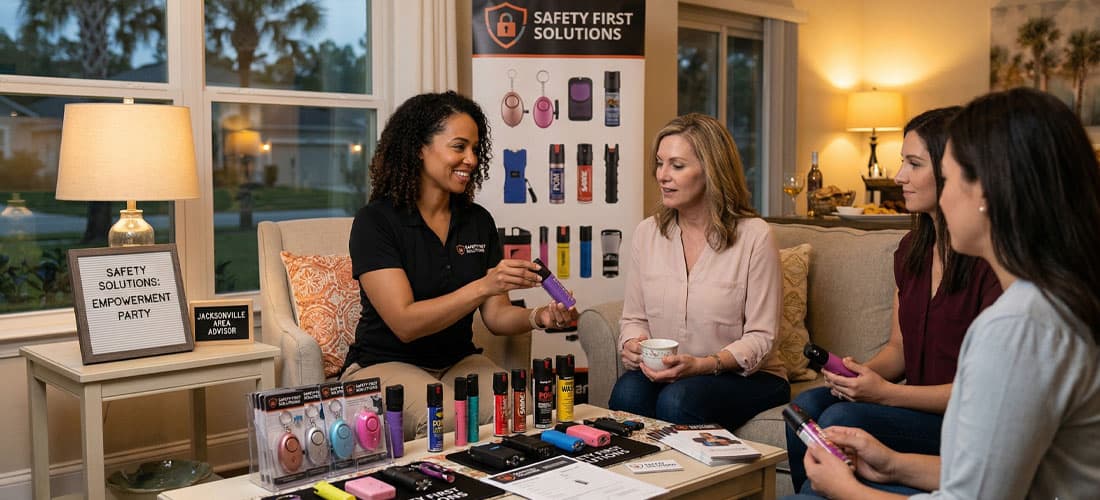
When Carolyn Waters told me what happened at her first home party, my honest reaction was: of course it worked. She was a nurse. Her coworkers had already seen her Mace keychain and asked where she got it. A real estate agent invited her to present to sixteen people in a living room full of neighbors who’d been invited by someone they trusted — and she wrote over $2,400 in orders. No advertising. No cold calls. No storefront. Just products that answer a question people were already asking, in a room where they had a reason to show up. That’s what makes the home party model different from every other channel in this business.
Why Selling Self-Defense Products Through Home Parties Works
Most retail selling puts you in front of strangers — people walking past a table, clicking through a website, scrolling past an ad. The home party flips that entirely. Your buyers are sitting in a living room because someone they know invited them. That’s a fundamentally different kind of trust, and it changes how people make decisions. They’re not guarded. They’re already in a social mood. They’re open.
Self-defense products are a natural fit for that environment in a way that kitchen gadgets or candles simply aren’t. Personal safety is something people think about but rarely act on — until someone puts a real product in their hands and walks them through it. The moment someone holds a pepper spray canister and understands how it works, or sees how a personal alarm operates, the decision gets a lot easier. That hands-on moment almost never happens in online shopping. It happens in a room with a knowledgeable person who can answer questions.
The buyers you’ll see at home parties are also among the most motivated in any channel. Women who’ve thought about personal safety but never pulled the trigger on a purchase. Parents who want something for a college student heading off to school. Nurses, teachers, realtors — professionals who work in environments where they’ve thought about this but never had access to good product. Once you’ve done a few parties, you start to recognize the look: someone picks up a product, turns it over, and says “I’ve been meaning to get one of these.” That’s your customer, and they’re everywhere.
Carolyn’s story isn’t exceptional — it’s what happens when you put the right product in front of the right room. The home party channel consistently produces one of the highest conversion rates of any selling model I’ve seen in this business, because the social environment does a lot of the selling before you even open your mouth.
What Moves at Home Parties: The Products That Sell
Pepper & Defense Sprays — 50–60% Dealer Margin
Pepper spray is the anchor product at every home party for a reason: the price point makes it an easy impulse buy, and the variety gives you something for everyone in the room. Pepper Shot, Wildfire, and Mace all have strong name recognition, and carrying a mix of keychain sizes, flip-top models, and police-strength formulas means guests can find something that fits their daily routine. At a party of fifteen people, selling five or six pepper sprays at retail isn’t unusual — and the margins make each one count.
Personal Safety Alarms & Keychains — 48–77% Dealer Margin
Personal alarms are the other reliable home party staple, and for good reason: they’re universally appropriate, completely legal in every state, and appeal to every demographic in the room — the college student, the grandmother, the woman who jogs alone. The margin range on this category is the widest in the catalog, and alarms priced at retail between $10 and $30 are genuinely easy impulse buys. Keychain combinations — an alarm alongside a small pepper spray — are natural bundle sells that home party guests respond to well.
Stun Guns — 40–66% Dealer Margin
Stun guns are the conversation piece at a home party. People are curious, they want to hold them, they want to understand how they work — and that hands-on curiosity translates directly into sales. Compact models and stun gun flashlight combinations tend to move best in the home party environment because they’re practical and easy to demonstrate. Before featuring stun guns, confirm which models are legal in your state using the guide at safetytechnology.com/stun-gun-laws/.
You’ll see wholesale prices for all of these — and every other category — once you complete the dealer application. There’s no cost and no commitment.
A Real Example: A Nurse Who Outsold Her Salary in a Month
Carolyn Waters was 22 years old and working as a registered nurse in Dayton, Ohio when this started. She wasn’t looking for a business. She wore a Mace keychain on her scrubs, and her coworkers kept asking about it. One of them — a real estate agent — said she wanted to buy some for herself and for the other women in her office, and invited Carolyn to come present to her living room group.
Carolyn had never done anything like it before. She set up her display in a living room with sixteen people she’d never met — all there because someone they trusted had invited them. By the end of the evening, she’d written over $2,400 in orders. The following month, she ran three home parties. She offered a portion of the sales to each host as an incentive, covered her product costs, and when the month was done, she’d made more from home parties than from her nursing job.
What I tell people when I share Carolyn’s story is this: she didn’t have sales experience, a business background, or a marketing budget. She had a product people were already asking for and a room full of people who had a reason to be there. That combination does most of the work on its own.
What You Actually Need to Get Started with Home Parties
The barrier to entry here is genuinely low — not “low” in the way that still means $3,000 upfront. You need a display of product, a willing host, and a date. Most dealers running home parties keep a core display of pepper sprays, a few personal alarms, and one or two stun gun models. You take orders at the party, then fulfill them through Safety Technology afterward. There’s no booth fee, no rental space, and no reason to carry inventory you haven’t already sold.
Finding your first host is almost always easier than people expect. You’re not asking them to do much — invite a group of people they already know, host for an evening, and in return they get a percentage of the night’s sales in cash or product. Most people in your existing network will say yes to that. Start with coworkers, neighbors, people from your church or civic group. The harder part isn’t finding the first host; it’s following through on the first party and building momentum from there.
One thing I’ve seen trip up new home party dealers: they underestimate how much the product demonstration matters. People buy at home parties because they handled something and it made sense to them. Spend time before your first event getting comfortable with every product in your display — how it works, who it’s right for, how to answer the common questions. That knowledge is what turns a curious guest into a buyer.
On the Safety Technology side: no minimum order, so you’re never forced to buy more than you need. Orders placed before 3 p.m. Eastern ship the same day. And if a guest orders something you don’t have in your display stock, we drop ship directly to them — no fee, your name on the package.
How Safety Technology Makes Home Party Selling Easier
The home party model has one consistent pressure point: the gap between when you take orders at the party and when customers receive their product. Your guests told their friends what they bought. Delays make you look unreliable. Safety Technology ships the same day on orders placed before 3 p.m. Eastern. That gap closes fast, and your customers get product while the party is still fresh in their minds.
The no-minimum policy matters more in this channel than people realize. Home party demand is uneven — one party might move a lot of pepper spray, the next might surprise you with stun gun interest. With no minimum order, you restock exactly what sold and nothing else. You’re not managing a warehouse; you’re managing a relationship with a supplier who ships what you need when you need it. And because we drop ship blind — your name on the package, not ours — any orders you fulfill after the event look like they came directly from you.
We’ve been at this since 1986. Over 300 products in the catalog, accessible once you’re approved. No drop ship fee. BBB A+ rated. Wholesale prices visible the moment you’re in.
A: Your main costs are the products you display and whatever you spend on a simple invitation — which can be as low as a phone call or a Facebook message. Most dealers start with a modest display order of $100 to $200 worth of product, show it at the party, take orders, and reorder only what sold. There’s no booth fee, no event space to rent, and no setup cost beyond the product itself.
A: Think of it like a Tupperware party, but with products people genuinely need. You lay out your display — pepper sprays, stun guns, personal alarms, diversion safes — and spend 30 to 60 minutes walking guests through what each product does and why they’d want it. People handle the products, ask questions, and place orders. The host gets a thank-you gift or a percentage of sales, which makes it easy to find willing hosts once you’ve done your first one.
A: In most states, selling at private events doesn’t require a special event permit the way a flea market booth might. You still need to operate as a legitimate reseller — a resale certificate is the standard requirement for becoming a Safety Technology dealer. Some products, particularly stun guns, have state-level restrictions. Check the current state-by-state guide at https://www.safetytechnology.com/stun-gun-laws/ before building your display.
A: This is one of the cleaner aspects of the home party model — you can take orders at the party and place them afterward rather than carrying a full inventory. Show product samples, collect payment, then order from Safety Technology and ship directly to the customer using our blind drop ship service. No drop ship fee, same-day processing on orders placed before 3 p.m. Eastern. You’re never buying a box of 50 units hoping they’ll move.
A: Start with people who already know you — coworkers, neighbors, church friends, family. Offer the host a percentage of the total sales from their party, typically 10 to 15 percent in product credit or cash. That’s an easy yes for most people, and a motivated host does a lot of the promotion for you. Once you’ve run a few successful parties, satisfied guests often volunteer to host their own.