

How to Sell Self-Defense Products to Businesses — No Storefront Required
Years ago one of our dealers — no office, no employees, working out of a spare bedroom — landed an account with a Hilton property. Not a chain deal. One property. One purchase order, a few hundred dollars in product, shipped the same day. That account reordered. Then he called another hotel down the street. That is how B2B works when you are selling something businesses actually need. You do not need a sales team or a showroom or a fancy pitch deck. You need a product that solves a real problem, a supplier who ships fast, and enough confidence to make the call.
Why Selling Self-Defense Products to Businesses Works
Most people, when they think about selling self-defense products, picture a flea market table or a website. Business-to-business is a different animal entirely — and in some ways a better one. When a company decides they need personal alarms for their nurses or pepper spray for their apartment complex staff, they do not buy one. They buy twenty. Or a hundred. One conversation can be worth more than a full weekend at a gun show.
The reason businesses buy these products is not complicated. They have employees in parking lots after dark. They have property managers doing walk-throughs alone. They have hotel staff working night shifts. Liability is real to them, and products that address it practically — without requiring a licensing program or a firearms policy — are an easy sell. Pepper spray and personal alarms fall squarely in that category.
What makes this channel genuinely different from retail is the relationship. A flea market customer buys once and you never see them again. A business account that reorders is an annuity. Get the right accounts and the business largely takes care of itself.
The other thing worth understanding is that businesses buy on logic, not impulse. They want to know the product works, they want a price that makes sense for their budget, and they want to know someone will answer the phone if there is a problem. That is a bar you can clear without a storefront or a sales team.
What Moves in B2B: The Products That Sell to Businesses
Pepper & Defense Sprays — 50–60% Dealer Margin
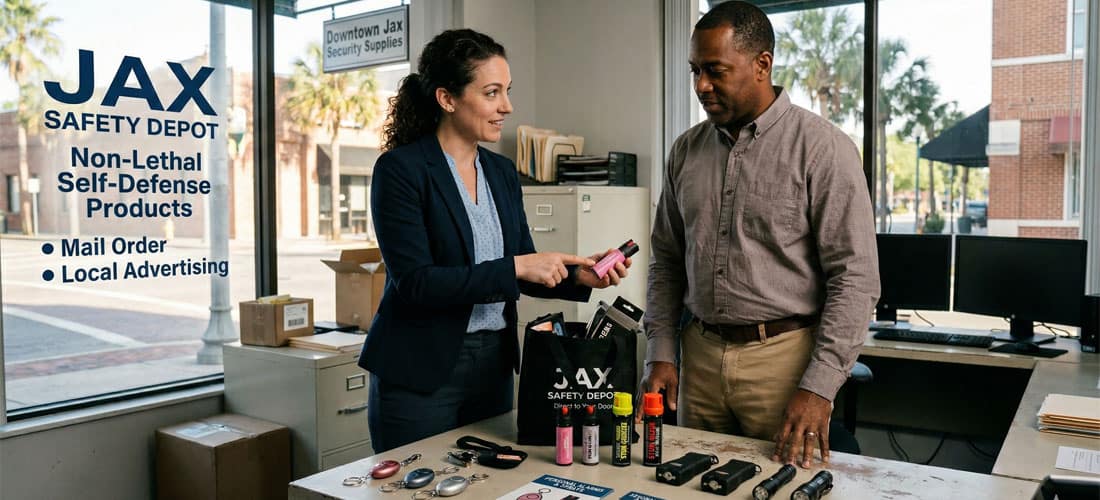
Pepper spray is the workhorse of every B2B account. Hotels buy it for housekeeping staff. Property management companies buy it for maintenance workers who enter occupied units. Real estate brokerages buy it for agents showing homes alone. The Mace and Wildfire lines move well in business settings because they are recognizable brands — buyers feel confident handing them to employees without a lot of explanation. The keychain sizes are the most popular; compact enough to carry on a lanyard and straightforward to use. Bring a few samples to your first meeting with a prospect and let them handle the product before you talk price.
Personal Safety — 48–77% Dealer Margin
Personal alarms are an easier conversation than pepper spray in some business environments — particularly healthcare, education, and any setting with an HR department that gets cautious about chemical agents. A 130dB personal alarm on a lanyard is hard to argue with. These also work well as employee appreciation gifts and safety-program giveaways, which gives you a second angle when approaching HR departments and office managers. The margins on this category are among the best in the catalog, and there are no legal restrictions on personal alarms anywhere in the country.
Covert Security — Consistent Margins, No Legal Restrictions
Diversion safes and dummy cameras sell reliably to property-focused businesses — small hotels, vacation rental operators, storage facilities, and retail shops that want visible deterrence without the cost of a real camera system. No legal restrictions in any state simplifies the conversation considerably. The 39 diversion safe models give you options for different settings: a can safe for a break room, a book safe for a reception desk. Business buyers appreciate having choices, and the margins leave room for a volume discount that still puts real money in your pocket.
You will see wholesale prices for all of these — and every other category — once you complete the dealer application. There is no cost and no commitment.
A Real Example: Building a B2B Account Base Without a Storefront
One of our dealers built a B2B business that included accounts with Hilton Hotels, Marriott Hotels, Exxon Mobil, the Mississippi Farm Bureau, and a California university. He did this without a commercial space, without a sales team, and without any prior background in corporate sales.
He started the way most B2B dealers do — with one account that led to another. A property manager he knew needed pepper spray for the staff. That conversation led to a referral. The referral led to a larger account. By the time he had the hotel relationships, he was not cold-calling anymore. He was processing reorders from companies that had heard about him through word of mouth. No minimums from Safety Technology meant he could say yes to a small test order without tying up capital. Same-day shipping meant he could promise delivery timelines that a larger distributor could not always match. The business ran lean by design — and it worked.
The takeaway is not that every dealer will land national brand accounts. It is that B2B sales compound. Each account you close correctly becomes a referral network. You do not need twenty clients who each order once. You need four or five who reorder every quarter.
What You Actually Need to Get Started with Business-to-Business Sales
The practical minimum is lower than most people expect. You need your Safety Technology dealer authorization, a working knowledge of what you are selling, and a clear answer to the question every business buyer asks first: can you get this to me reliably? Same-day shipping from our warehouse is your answer to that.
A focused one-page product sheet helps. Not a full catalog — a document showing the two or three products most relevant to the type of business you are approaching, with pricing that leaves room for a small quantity discount if they ask for one. You do not need a website to start, though it reinforces credibility when a buyer looks you up after a meeting.
Where new dealers underestimate this channel is in the follow-up. B2B decisions rarely happen after one conversation. A hotel manager who says “that sounds interesting” and then goes quiet for two weeks is not saying no. That is a busy person who needs a second touchpoint. The dealers who do well here stay organized — they track who they have contacted and follow up without being a pest about it.
Budget-wise, you can start with almost no upfront inventory because Safety Technology has no minimum order and no drop ship fee. The product ships blind from our warehouse directly to your account’s location, under your business name. Your cost stays near zero until the sale is already made.
How Safety Technology Makes B2B Sales Easier
The biggest problem in B2B selling is promising something you cannot deliver. Same-day shipping from Safety Technology means you can commit to delivery timelines with confidence. When a hotel general manager needs product before a conference next week, you can say yes and mean it. That kind of reliability is what turns a one-time account into a long-term relationship.
Blind drop shipping matters here in a way it does not in flea market selling. When you drop ship directly to a business account, the package arrives with your business name on it — not Safety Technology’s. To the client, you are the supplier. That protects your account relationship and lets you operate professionally without maintaining your own warehouse or shipping staff.
No minimums mean you can take a small test order from a new account without asking them to commit to a quantity they are not ready for. Let them try twenty units. When they reorder sixty, you have a real account. With nearly 40 years in business and over 300 products in the catalog, we have enough depth to grow with any account you bring on.
A: Start with businesses that already care about employee or customer safety — hotels, property management companies, staffing agencies, real estate offices, healthcare facilities, and schools. Many of these organizations buy in quantity because they have a recognized liability and a practical need. Cold calls and emails work, but a warm introduction through a local chamber of commerce or business association often gets you in the door faster. Your local business community is smaller than you think, and one good referral from a satisfied account can open three more doors.
A: Not really. What you need is the ability to have a straightforward conversation about a problem the business already knows it has. Most business buyers respond to honesty and specifics — here is what the product does, here is what it costs, here is how fast I can get it to you. The dealers I have seen do well in B2B are not professional salespeople. They are practical people who take the time to understand what the business actually needs before they walk in the door.
A: No minimums mean you can fulfill a small test order for a new business account without overcommitting your own capital. Same-day shipping means when a company needs product by the end of the week, you can deliver on that promise. And blind drop shipping lets you fulfill orders directly to a business location without running a warehouse — the package comes from you, not from us. That combination lets a single dealer operate at a professional level without the overhead of a real distribution business.
A: Yes, and they vary by state and product type. Stun guns have state-level restrictions you need to know before you sell. Pepper spray is legal in all 50 states for adults, though some states have size or concentration limits. Before you approach businesses in a new state, review current laws at https://www.safetytechnology.com/stun-gun-laws/ and factor that into what you offer. Personal alarms and diversion safes carry no legal restrictions anywhere, which makes them a clean fit for any B2B account regardless of location.
A: Handle it directly and quickly. In B2B sales, your reputation with an account is everything — one problem handled well often cements the relationship better than a sale that went perfectly. Safety Technology products are well-made and defects are rare, but if a business has an issue, reach out to us and we will work through it with you. The accounts worth having are the ones that reorder, and they reorder from dealers who stand behind what they sell.